
Here’s a hard truth many leaders discover too late: business growth often creates more internal chaos than market success. Teams get bogged down. Simple tasks become complicated. The excitement of scaling quickly turns into frustration.
We see it all the time. Companies move from a tight-knit startup to a growing organization. Their old ways of working just break. They need a new system built for this phase.
That’s why we built our platform. It’s the honest, powerful tool you need to handle this complexity. It gives your people clear control over their workflows and data. You stop fighting your infrastructure and start driving real business growth.
Talk to our team today. See how our software solutions can cut through the noise. Call our experts directly at 435-295-2877. Let’s fix this, together.
Key Takeaways
- Rapid business growth frequently leads to internal confusion and process breakdowns.
- The transition from startup to a larger company requires a fundamentally different approach to handling work.
- A dedicated platform is essential for maintaining control and alignment across expanding teams.
- The right tools directly translate to better efficiency and a stronger foundation for scaling.
- Expert guidance is available to help you navigate this critical phase—reach out for a direct conversation.
Understanding the Role of Scalable Operations Management
Many companies hit a wall when their old methods can’t keep up with new demands. This is the scaleup phase. These are firms with 50 to 500 employees growing fast. They are entering new markets, opening offices in different countries, and often doubling their workforce each year.
This kind of expansion changes everything. The way you worked with a small, tight group simply breaks. You need a new foundation.
Defining Scalable Operations Management
So, what is it? It’s your ability to grow without creating internal chaos. It’s about building systems that support more people and more complex workflows. The goal is to keep control and let your team execute smoothly, no matter how big you get.

For leaders, this means a major shift. You stop wearing every hat. Instead, you focus on designing the infrastructure that empowers your entire organization. This is the core of long-term success.
The Impact on Business Growth and Efficiency
Without clear processes, things go wrong. Emails vanish. Projects delay. Customer experience suffers. This directly hurts your efficiency and stalls your business growth.
Get it right, and the impact is powerful. You gain agility. Your company can adapt quickly. You save time and lower costs. Growth becomes a controlled ascent, not a frantic scramble.
We help make this shift. We move you away from manual, email-driven tasks to a structured solution built for a growing business.
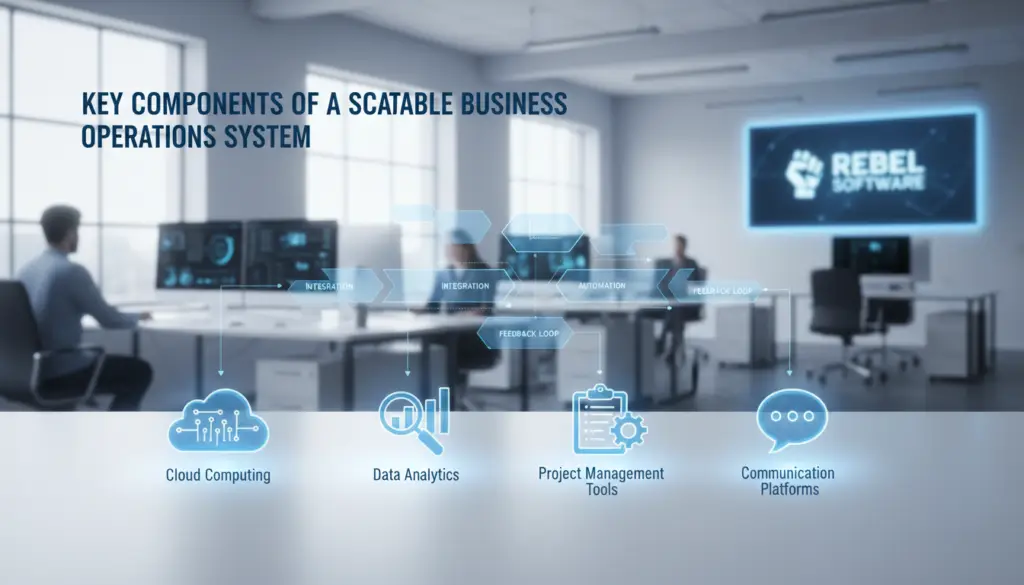
Key Components of a Scalable Business Operations System
Your people, your processes, your tools. Alone, they’re just pieces. Together, they’re a powerhouse.
A true business operations system connects them into one framework. This is the engine for performance and long-term growth. It’s the difference between hoping for scalability and building it.
Strategic Vision and Process Documentation
First, you need a clear destination. Define your long-term vision in one place. It acts as a compass for every decision your people make.
Then, document how work gets done. Clear processes turn that vision into action. They eliminate guesswork and create consistent workflows.
Resources like Business in a Box offer SOP templates for over 1,900 business tasks. This saves immense time and ensures your company runs the same way every day. Solid operations start here.
Structuring Teams and Leadership for Expansion
As you grow, your old team structure cracks. The solution isn’t more layers of management.
Build semi-independent pods or units. Each team follows the same core system but owns its outcomes. This structure fuels growth without creating chaos.
Leaders shift from doing tasks to empowering their teams. You design the infrastructure that lets the entire organization move faster.
Integrating Technology and Tools
The average small business uses 12 to 20 different apps. This sprawl creates fragmented data and daily frustration.
Integrating technology is non-negotiable. Your tools must talk to each other. Choose software that unifies, not divides.
Look for platforms built for connection. This reduces complexity and paves the way for smart automation. Companies that get this right gain a massive advantage.
Best Practices for Scaling Operations
Let’s cut to the chase: your growth will stall if your daily work relies on tribal knowledge. Replacing improvisation with intention is the only way forward.
We built our platform on two non-negotiable principles. They turn chaos into a controlled ascent.
Establishing Clear and Repeatable Processes
If only a few people know how something works, your business isn’t ready to scale. Documented processes are your new foundation.
They eliminate guesswork for everyone. New teams can onboard faster. Work gets done the right way, every time.
Start by ranking your daily tasks. Which ones are repetitive and information-heavy? These are your first targets for automation.
Implementing Built-In Approvals and Automation
Think about expense reports. A tool like Spendesk lets employees manage spending needs directly. It cuts the finance team’s burden while keeping full control.
That’s the power of built-in workflows. You save major time on administration. Your people get what they need to move fast.
Automation handles the volume so your systems don’t break. The right software embeds these guardrails directly into your solutions. This is how you enable true, sustainable scaling.
Leveraging Technology and Automation for Operational Efficiency
Stop letting disconnected apps drain your team’s time and morale. The right technology stack is a force multiplier. It turns daily friction into smooth workflow.
McKinsey research shows a massive opportunity. Up to 45% of work can be automated. For an average small company, that’s over 20 hours saved every week.
Selecting the Right Software and Tools
Popular platforms like Salesforce and HubSpot win for one reason. They give your entire team universal access to information. Work happens from anywhere.
Look for tools that build autonomy into the process. For example, Payfit lets new employees handle payroll steps directly. They check payslips and request time off without waiting for a manager.
Your software must connect. Use tools like Zapier to link apps that don’t talk natively. This keeps your data flowing and prevents silos.
| Selection Criteria | The Old (Inefficient) Way | The Smart (Efficient) Way |
|---|---|---|
| Access & Mobility | Manual downloads, desktop-only access | Browser-based platforms that work on any mobile device |
| Integration Ability | Standalone apps creating data silos | Native APIs or easy connectors like Zapier |
| User Empowerment | Constant manager intervention needed | Self-service features built into the workflow |
| Impact on Time | Creates administrative drag and manual tasks | Designed to save 20+ hours per week through automation |
This table isn’t just theory. It’s the blueprint for choosing tools that deliver real efficiency. The goal is a unified system that works for your team, not against it.
Conclusion
Consider the story of NovaBuild Construction Group. This 40-person firm improved project delivery times by 25% after adopting a structured system. The payoff is real.
Building this foundation for growth requires effort. It pays dividends by reducing operational costs and increasing productivity across your entire business.
Don’t wait for an ideal time to fix your process. Expansion magnifies every crack in your system.
Need expert guidance? Call our support team at 435-295-2877. We can help. Remember, true scaling isn’t just about doing more. It’s about doing better work through proven systems and reliable technology.